Advanced biocomposites with circular design – a way to an improved future?

The ABiCo – Advanced biocomposites with Circular Design – project aims to develop innovative high-performance biobased biocomposite solutions to replace fossil-based primary raw materials. It will increase the use of recycled polymers and biobased raw materials in new demanding applications in accordance with the principles of the circular economy.


ABiCo catalyses cross-disciplinary research, innovation capacity and development of sustainable bio-based innovations, integrating sustainability throughout the innovation chain.


The current situation in biocomposites

Global and EU-level regulations for improved sustainability in material origin and improved circulation potential are the main drivers towards biocomposites, which are to some extent already in use, e.g., end-use applications in construction, automotive and many consumer products.

A large proportion of composites are currently made from fossil-based raw materials ->  There is a need and demand to use also raw materials from other sources.

Biocomposites have been available on the market for decades, but their use has been restricted to limited application areas due to their current performance levels and processability. Now, many industrial areas and brand owners around the world are demanding biocomposites that have better performance levels, suitable for high quality products.


Background

Companies are searching for more sustainable alternatives to plastics and composites. 

ABiCo was initiated based on these business needs.

Biobased fibres, additives, and recycled polymers enable a significant reduction in emissions while also enhancing the competitiveness of businesses and creating opportunities for new business

Biocomposites are not currently recycled as material and their main end-use is energy recovery. There are recyclability bottlenecks in collection logistics, identification and separation, and novel uses of recycled biocomposite material.

Limitations include not being fully compatible with current industrial processing, not being able to fully meet target application requirements such as flame retardance, and/or their higher cost vs existing solutions.

Key challenges with biocomposites are their structural and functional behaviour, identification of raw materials for recycling, extraction processes, sustainable feedstock, implementation of biocomposite interfacial properties, material processing and product manufacturing, and safe service life and product design.


The ABiCo project is funded by the Business Finland “Expand Fibre” ecosystem.

Project timeline: 8/2024–8/2026

The aim of ABiCo 

  • ABiCo will demonstrate the production of demanding added-value bio-based composite materials and products made from bio-based natural fibres, including wood fibres and/or bio-based synthetic fibres in bio-based or recycled thermoplastic matrices.
  • In addition to the demonstration of innovative composite product prototypes, the project will demonstrate novel fibre treatment methods, bio-based matrices, as well as full formulation with relevant innovative bio-based additives.
  • Circular and environmental design perspectives will be integrated into the development processes to identify the user needs or industry requirements as early as possible.
  • Novel material compositions will be created, and their properties and processing will be tested against different industrial processing methods.
  • The choice of end-of-life option must be compatible with application and technical performance requirements in LCA terms, as well as aesthetically and functionally.
  • The public research carried out in this project will support the industrial partners in their own parallel research projects.

Outcomes of ABiCo

  1. Processing: Biocomposite material solutions will be provided for demanding applications using industrial production technologies.
  2. Performance: Relevant demo and early-stage prototype products will be delivered for industry demo applications
  3. Circularity: The recyclability and reuse of the biocomposites developed will be demonstrated
  4. The environmental benefits and regulatory compliance of the solutions developed will be assessed and documented:


    • Assess the environmental impacts of products made of advanced biocomposite materials and prove their positive climate impact
    • Generate knowledge on how new environmental legislation will affect the business models and company responsibilities on all levels of the value network
    • Study new business models that are viable for international industrial scale production of biocomposites.


The research consortium

Five research institutions each have their own special role in the project:

Åbo Akademi, VTT, LUT University, LAB University of Applied Sciences, and the University of Eastern Finland. 

The consortium also includes companies representing various industry sectors

Industrial project partners in the project consortium:

NG Nordic, Metsä Group, Durat Tonester, Brightplus

Other company partners:

Vaisala, Pihla, Meyer Turku, Syklo Biocomposites Oy, TK-Tiimi


The ABiCo project approaches business opportunities from three perspectives,

which are organized into five Work Packages:


  • Raw materials and processing
  • Design and End-of-Life solutions
  • Demonstrations and feasibility
  • Communications and dissemination
  • Project management


Roles

  • Raw material selections main responsibility together with partners
  • Fibre treatment, biocomposite recipes and compounding development
  • Processing of biocomposites in industrial processing – especially focusing on injection moulding in the processing of biocomposites
  • NDT (non-destructive testing) techniques
  • AI based modelling in recipe development and material/process design
  • Mechanical recycling of biocomposites
  • Regulatory studies on EU and national policy instruments that affect use and recycling of biocomposites


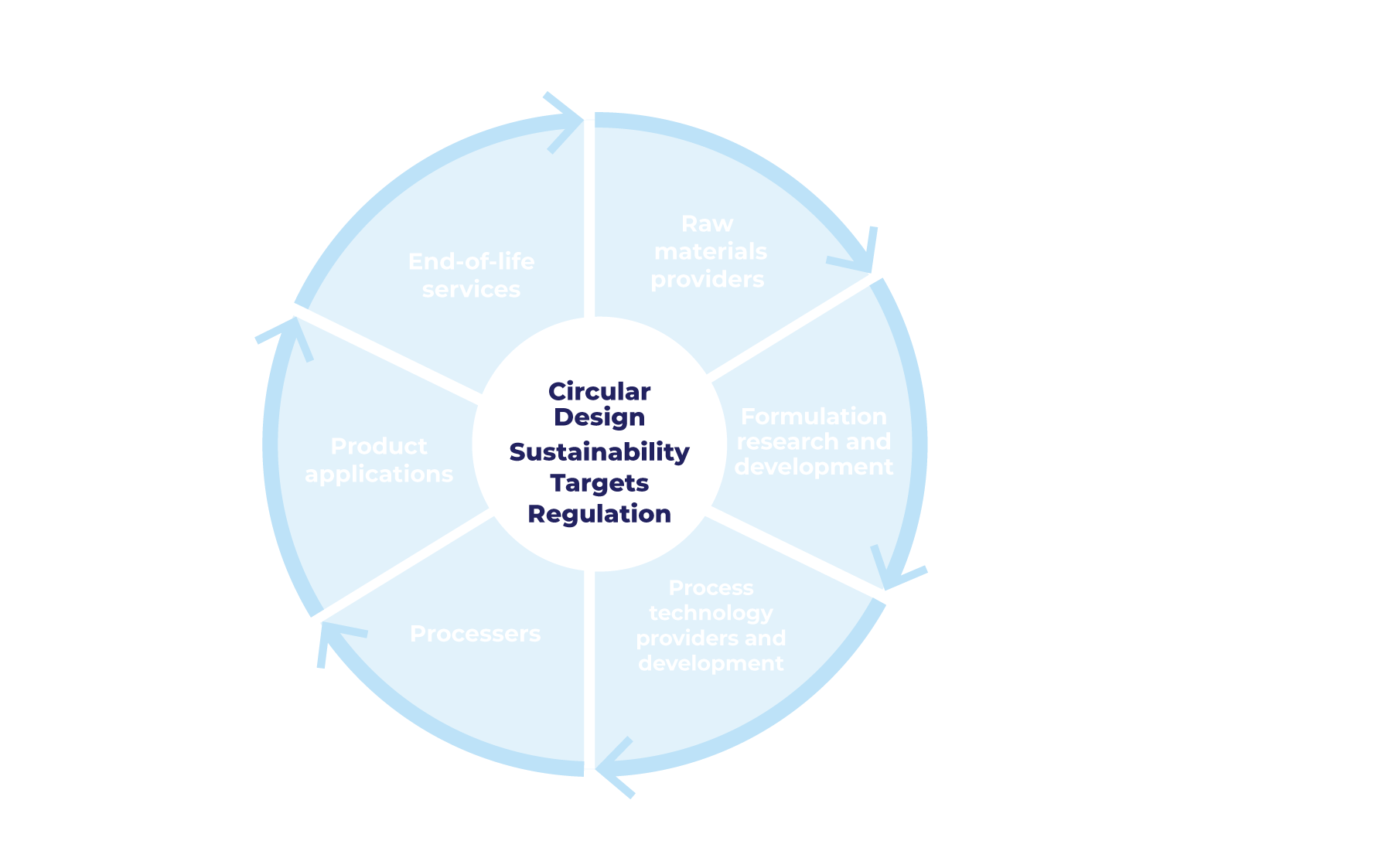
  • Circular design - ABiCo aims at integrating the circular design ideology in biocomposite development starting from raw materials to product design and end-of-life.
  • Demo products will be designed for the project.
  • Assessing environmental performance of the demo products, life-cycle assessment (LCA) studies of biocomposites
  • End-of life of biocomposites


  • Processing technologies for biocomposites – especially extrusion and 3D printing of biocomposites
  • Tooling for processing of biocomposites
  • Producing demo products
  • Creating a multi-optimization model to demonstrate the greatest potential of different biocomposite compositions and processing methods
  • Assessment of demos protos and concepts based on industry challenges (processing defects, joining and fasteners of biocomposites)
  • Preliminary techno-economic evaluation (TEA) of biocomposites processing
  • Coordination of communication and dissemination of the results
  • Development of biobased additives for biocomposites
  • Assessing mechanical performance requirements for biocomposites
  • Mechanical performance and testing of demo biocomposites
  • Structural charaterization of new biocomposited produced
  • Environmental performance and toxicity of new biocomposites produced
  • Needed non-destructive testing (NDT)  for analysing material properties
  • Utilizing biocomposites in new advanced applications requires compatibility with application requirements, such as flame retardance.
  • Design and synthesis of flame-retardants and their characterization
  • Green fire retardants for compounds
  • Introducing flame-retardants via impregnation of fibres, mixing with polymer (or biocomposite) or by coating
  • Performance data related to application conditions (weather resistance, fire retardance, UV resistance, color stability, exposure to micro-organisms)